Flexo printing – why is it an essential technology in high-volume production?
Flexo is the most cost-effective solution for large-scale production.
Flexo printing – why is it an essential technology in high-volume production?
Labeling and packaging are among the most critical aspects of product manufacturing. It's not just about appearance and branding, but also logistics, efficiency, and cost-effectiveness. Although digital technology has received a lot of attention in recent years, there is one area where there is simply no better solution: flexo remains unbeatable for high-volume, high-speed, continuous production.
It is no coincidence that flexographic printing is the most widely used technology in the label industry worldwide. It is the solution that meets the requirements of mass production while ensuring excellent quality, speed, and color consistency—with a level of scalability that no other technology can match.
That is why flexo is still one of the most important printing forms on the market.
What is flexographic printing?
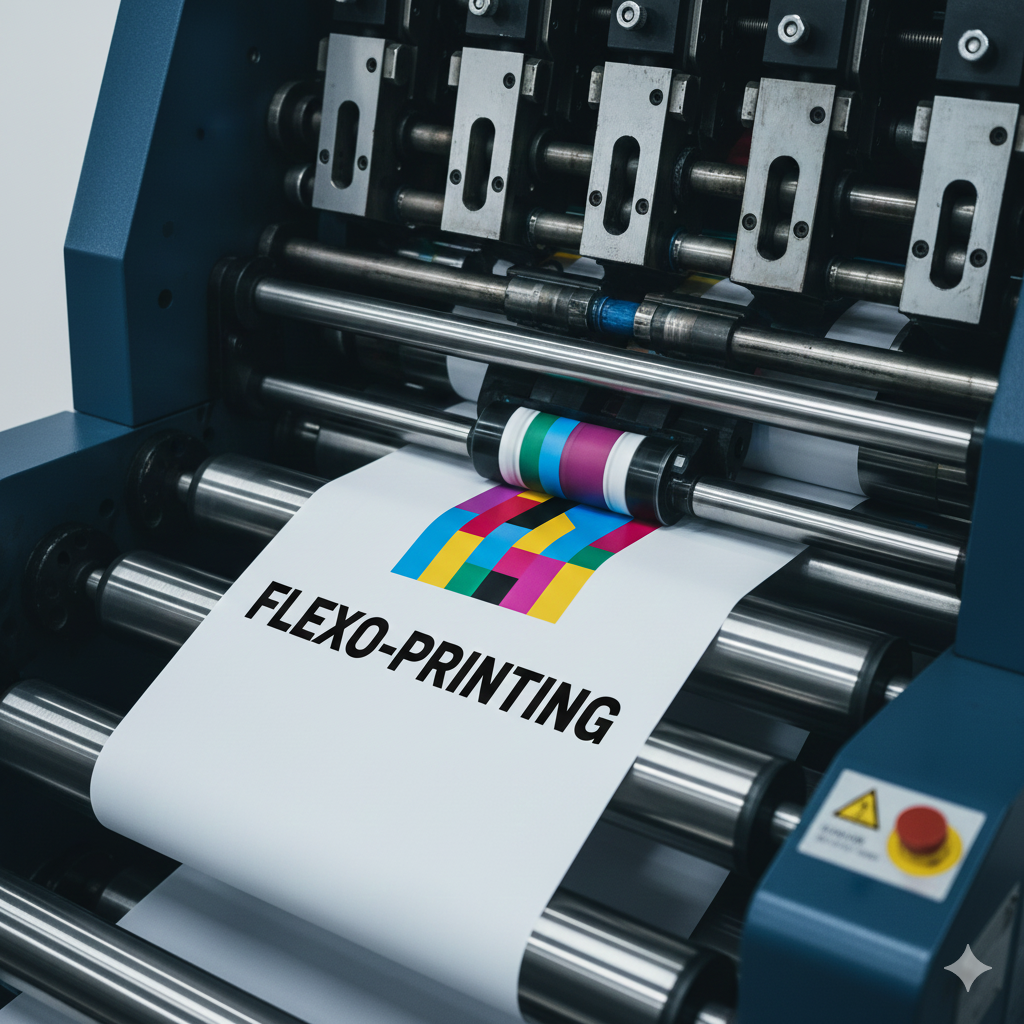
Flexo technology is a modern, continuous roll-to-roll printing process in which ink is transferred to the substrate using a photopolymer printing plate. This system is extremely reliable, fast, and capable of high color intensity—which is exactly what makes it ideal for large-volume production.
Advantages of flexographic printing
1. The most cost-effective solution for large volumes
Flexo really comes into its own when thousands or hundreds of thousands of labels are produced in a single production run. One of the biggest advantages of this technology is that
The greater the quantity, the lower the unit cost.
In flexographic printing:
- very low specific cost for large quantities,
- the machines are producing at maximum speed,
- optimized for long runs.
This is precisely why it is used in huge quantities in the FMCG sector, the beverage industry, the food and cosmetics industry, and the chemical industry.
2. Outstanding color quality, precise color accuracy
One of the most popular features of flexo technology is color quality. It provides stable, consistent results with excellent resolution.
Today, flexo is:
- supports PANTONE paints,
- spot colors,
- metal paints,
- thick layer of paint and high coverage.
All this with exceptional consistency and reliability.
For products where brand color is critical (e.g., beverages, cosmetics, premium products), flexo ensures color consistency from the first meter to the last.
3. Fast industrial production, high speed
Flexo machines are capable of printing continuously at high speeds. This is particularly important when production:
- requires large quantities.
In such cases, flexo is the industry standard. It is no coincidence that the vast majority of the world's largest manufacturers use flexo technology for mass production.
4. Wide range of materials – from paper to special industrial films
Flexo is just as versatile as digital when it comes to substrates, and even performs better on certain materials:
- paper, cardboard, kraft
- PP, PE, PET, PVC
- heat-resistant materials
- chemical-resistant labels
- industrial packaging materials
- shrink wrap
- flexible packaging films
Flexographic printing can handle not only labels, but also:
- packaging film,
- bag,
- bag,
- plastic packaging materials.
Scalability is the key word here.
The limitations of flexo – and why it's important to know them
Although flexo has enormous advantages, there are areas where it is less flexible than digital printing.
1. Higher setup and preparation costs
For flexion, you need:
- on a pressure plate,
- tools,
- machine settings.
Therefore, every change incurs a cost.
This means:
- A small modification or new design can mean new costs.
- manufacturing multiple product variations is more difficult,
- smaller quantities are not economical.
2. Less flexible to change
In a world where companies often need to change product names, ingredient lists, designs, or languages, flexo has the disadvantage of:
- slower cycle time,
- more expensive change,
- more difficult customization,
- minimum quantity characteristic.
Therefore, this is not usually the best solution for small-batch production.
3. More time and planning are needed
Flexo printing is a large-scale solution. It is ideal if:
- production can be planned in advance,
- large quantities are needed,
- Long runs are coming up.
This is not the kind of technology where last-minute changes can be made.
Who is flexographic printing particularly recommended for?
For customers who:
- order in large quantities,
- color stability is important to them,
- They operate in the FMCG, food industry, chemical industry, beverage production, and retail sectors.
Flexo printing is not only efficient for large batches, it is also the best solution.